You know that feeling when you walk into a store and instantly know where everything is? Bread on the left, dairy in the back, snacks strategically placed where your willpower goes to die. That’s not random. It’s retail psychology.
Now compare it with the online version: you land on a store, the page takes forever, categories feel like a junk drawer, filters produce 73 versions of the same URL, and you’re two clicks away from giving up and buying from someone else who made it easier.
That’s ecommerce SEO in one sentence: making your store easy to find and easy to buy from–at the same time.
And yes, you can “solve” traffic with paid ads. For a while. But ads are like turning on a faucet you don’t own. The moment you stop paying, the water stops. SEO is different. SEO is building a well in your backyard.
E-commerce SEO is not about chasing rankings or playing keyword games. The real benefits of e-commerce SEO become apparent when an online store becomes easier to find, more trustworthy, and more convenient to buy from. Done properly, it reduces customer acquisition costs, improves conversion rates, and turns search traffic into a compounding revenue asset instead of a volatile expense.
If you run an online store and feel trapped between rising ad costs, inconsistent traffic, and a website that “works” but doesn’t really convert, this article will show you exactly why e-commerce SEO becomes the foundation for sustainable growth.
Let’s break down what ecommerce SEO really is, why it matters, and the benefits that show up not as “vanity metrics” but as actual revenue, lower CAC, and a store that feels like it was designed by someone who understands humans.
What Is E-commerce SEO?
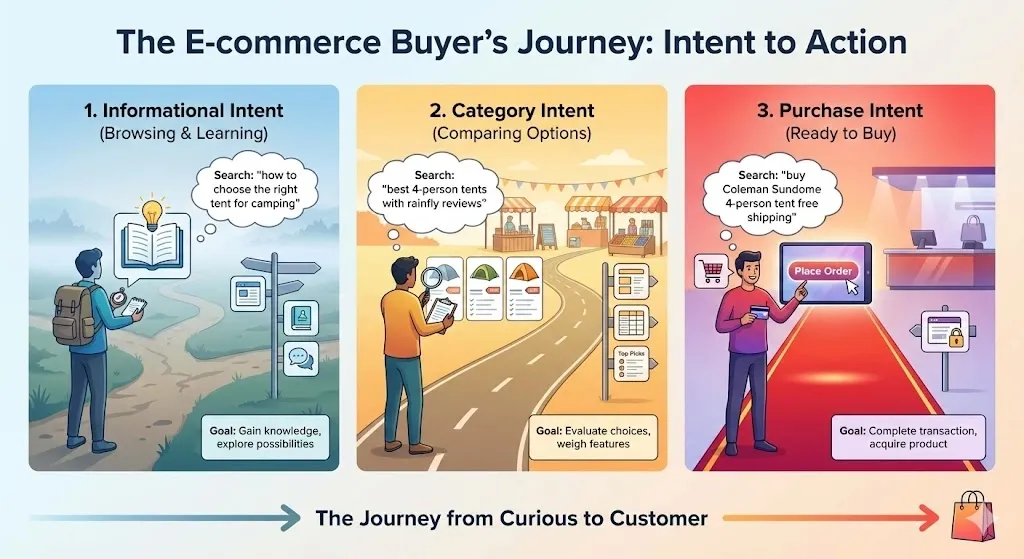
E-commerce SEO is the practice of optimizing an online store so that product pages, category pages, and other commercial pages rank in search engines and attract people who are already looking for what you sell.
But let’s remove the fog. Nobody wakes up and thinks, “Today I will experience an optimized canonical tag.”
They think:
- “best running shoes for flat feet”
- “oak dining table 180cm”
- “iPhone 15 case magsafe”
- “organic dog food reviews”
That’s demand. Real, human demand.
E-commerce SEO helps your store appear in those moments–when someone is close to making a purchase, not just browsing for entertainment.
E-commerceas if SEO in plain English
In plain English, e-commerce SEO is a mix of:
- Being discoverable (Google can find and understand your pages)
- Being relevant (your pages match what people search)
- Being trustworthy (signals like reviews, authority, brand presence)
- Being usable (fast, mobile-friendly, easy navigation)
- Being persuasive (product pages that actually answer questions)
What you’re really optimizing for: humans, not robots
Here’s the part that most people miss: search engines are just proxies for humans. Google doesn’t “reward” you because you used a keyword 11 times. Google rewards you when users behave as if your page helped them.
Click. Stay. Scroll. Compare. Add to cart. Buy.
SEO is not a game of pleasing robots. It’s a game of reducing friction for humans–while making it obvious what you sell and why it’s the right choice.
How E-commerce SEO Differs from Traditional SEO
Traditional SEO often leans toward informational: blog posts, guides, definitions, thought leadership. E-commerce SEO is more transactional. It targets “money pages.”
Product intent vs informational intent
Traditional content: “How to choose a mattress”
E-commerce content: “queen memory foam mattress 12 inch price”
Both matter, but the intent is different. Informational traffic warms people up. Transactional traffic pays rent.
The “catalog problem” (and why most stores fail here)
E-commerce sites aren’t 20 pages. They’re 2,000 pages. Sometimes 200,000.
That creates problems that regular websites don’t have:
- Duplicate pages from filters and sorting
- Thin content on product pages
- Category pages that are basically empty grids
- Crawl budget waste (Google spends time on junk URLs)
- Constant changes (products go out of stock, new SKUs appear)
So, e-commerce SEO is less like “writing a few optimized pages” and more like building a scalable system that stays healthy as the catalog grows.
Why Ecommerce SEO Is Important for Online Businesses
If you sell online, you’re competing with two enemies:
- Other stores
- Human impatience
SEO helps with both, because it brings qualified traffic and forces you to improve the store experience.
The Role of Search in Ecommerce Buying Journeys
Search is the most honest channel in marketing.
On social media, people scroll to avoid boredom. On Google, people search to solve a problem. That’s a completely different brain state.
Search is the new shop assistant
In a physical store, a good assistant asks:
- “What’s your budget?”
- “What size do you need?”
- “What will you use it for?”
Online, search does that job. People tell you what they want using keywords. Your job is to show up with the right answer.
Micro-moments: “compare,” “reviews,” “best,” “near me,” “buy”
Buying journeys are rarely linear. A typical shopper:
- searches “best espresso machine under 300”
- reads reviews
- compares specs
- checks availability
- looks for discounts
- buys when it feels safe
SEO lets you be present across those micro-moments so the customer keeps meeting you, again and again, until your brand feels familiar.
And familiarity is not a “nice-to-have.” It’s a survival mechanism.
E-commerce SEO vs Paid Advertising: Long-Term Value
Paid ads are powerful. No moral panic here. But they’re unstable. Multiple studies show that organic search delivers stronger long-term ROI compared to paid acquisition channels once the initial investment stabilizes.
Renting attention vs owning demand
Ads: you rent attention.
SEO: you earn placement where demand already exists.
With ads, you’re paying for every click. With SEO, you’re investing upfront and then benefiting repeatedly.
The compounding effect (the only “hack” that’s real)
SEO compounds because:
- content gains authority over time
- links accumulate
- brand searches increase
- rankings stabilize
- conversion optimization improves alongside SEO work
You don’t just get traffic. You build an asset.
Key Benefits of E-commerce SEO
Let’s get specific. Not “SEO is good.” What does “good” look like in an online store?
Increased Organic Traffic to Product and Category Pages
Most e-commerce stores obsess over blog traffic. It feels productive. It’s also often the wrong priority.
The money is in category pages and product pages–the pages that match purchase intent.
Why category pages are your real money pages
Category pages rank for broad, high-intent searches like:
- “men’s waterproof hiking boots”
- “wireless noise-cancelling headphones”
- “baby stroller travel system”
These pages can drive huge volumes of qualified traffic because they match how humans shop: they don’t always know the exact SKU yet. They know the type.
When category pages are optimized (text, filters, internal links, schema, UX), they become mini landing pages for demand.
Higher Conversion Rates from Purchase-Ready Visitors
Here’s a simple truth: not all traffic is equal.
A person searching “what is CRM” is not in the same mental state as someone searching “buy CRM for small business.”
SEO helps you attract people whose intent is closer to purchase.
Intent is the difference between traffic and revenue
Purchase-ready visitors:
- spend less time “researching basics”
- ask fewer beginner questions
- compare fewer irrelevant alternatives
- convert more often
That’s why e-commerce SEO isn’t just about more visitors. It’s about better visitors.
If you’ve ever run ads broadly, you know the pain: lots of clicks, low conversions, and a feeling that you’re paying for tourists. SEO, done well, attracts locals who actually came to buy.
Improved User Experience Across Your Store
You can’t do serious SEO without touching UX. They’re tied at the hip.
- site speed affects rankings and bounce
- navigation affects crawlability and user flow
- content clarity affects engagement and conversions
SEO and UX are the same game
A well-optimized store usually has:
- clear hierarchy (categories → subcategories → products)
- clean URLs
- consistent internal linking
- fast mobile performance
- product pages that answer real questions
The result is a store that feels easier to use–and easier stores make more money. Not because of “design trends,” but because humans conserve energy. We choose the path of least resistance.
Stronger Brand Visibility and Trust
Ranking repeatedly in search results has a psychological effect. Your brand becomes familiar. Familiar becomes safe. Safe becomes chosen.
Familiarity bias: your brain loves “safe”
Humans don’t like uncertainty. We pretend we’re rational, but we’re basically pattern-recognition machines with a fear of regret.
When someone sees your brand:
- in organic results
- in “People also ask”
- in product snippets with reviews
- in “best of” roundups
…your store starts to feel like a real player. And trust is often the deciding factor when price is similar.
Lower Customer Acquisition Costs Over Time
CAC is where businesses go to die quietly.
At first, ads look amazing. Then competition rises, CPMs go up, conversion rates fall, and you’re paying more for the same revenue.
SEO helps stabilize CAC because organic clicks don’t charge you per visit.
CAC reality check
Here’s a simple comparison table:
| Channel | Cost model | Stops when you stop paying? | Compounds over time? | Best for |
|---|---|---|---|---|
| PPC | Pay per click | Yes | No (mostly) | Speed, testing, launches |
| SEO | Invest in assets | No | Yes | Sustainable growth, margin |
| Social organic | Attention + consistency | Not instantly | Sometimes | Community, brand |
| Owned audience | No | Yes | Retention, LTV |
SEO doesn’t eliminate ad spend. It gives you leverage. It lets you choose when to pay–not because you must, but because it makes strategic sense.
Scalable Growth Without Increasing Ad Spend
Scaling with ads often feels like running up an escalator that’s going down. You work harder and still end up in the same place.
SEO scaling is different. You add:
- more optimized categories
- better internal links
- stronger topical coverage
- structured data
- improvements to product templates
…and the system grows without proportional cost increases.
Scaling with ads is like running up an escalator
With ads, growth often means:
- bigger budgets
- more creatives
- more audiences
- more retargeting
- more leakage
With SEO, growth often means:
- better structure
- better content
- better technical hygiene
- more authority
You’re building a machine, not buying fuel every day.
Measurable ROI Through SEO Analytics and Insights
Some people still talk about SEO like it’s mystical. It’s not.
You can measure:
- rankings (useful, but not the point)
- organic traffic by page type
- assisted conversions
- revenue per landing page
- conversion rate from organic
- lifetime value by acquisition channel
- crawl errors and indexation health
SEO is measurable–if you measure what matters
If you only track traffic, you’ll optimize for traffic. And traffic alone is cheap.
Track revenue, margin, and conversion pathways. That’s where e-commerce SEO becomes a business function, not a marketing hobby.
How E-commerce SEO Improves User Experience
SEO forces you to face reality: people don’t “explore” your store. They hunt for answers.
Faster Page Load Speeds and Mobile Optimization
Speed is not just a metric. Speed is a feeling. Page speed isn’t abstract – it’s measurable through real-world performance metrics that show how users actually experience your store.
If a page is slow, humans don’t think:
“Ah, the server response time is suboptimal.”
They think:
“This store is annoying.”
Speed is a feeling
Speed improvements usually come from:
- compressing images
- using modern formats (WebP/AVIF)
- reducing script bloat
- caching and CDNs
- cleaning up app/plugin overload
Mobile optimization is the same. Most e-commerce traffic is mobile-heavy in many niches. If your mobile UX is clumsy, your SEO and conversions bleed out quietly.
Better Site Architecture and Navigation
Your store is a map. If the map is confusing, people leave.
Good architecture helps:
- users find products faster
- Google crawl and understand pages
- link equity flow to important pages
Your store is a map–don’t make it a maze
A practical structure:
- Home
- Category
- Subcategory
- Product
- Subcategory
- Category
Keep it predictable. Humans like predictability. Predictable feels safe. Safe sells.
Also: filters are useful for users, but they can become SEO chaos if every filter creates a crawlable URL. That’s a technical + UX balance problem. Solve it once, properly, and you stop leaking authority.
Optimized Product Pages That Drive Engagement
Product pages are not “SKU pages.” They’re persuasion pages.
Product pages as persuasion pages
A strong product page usually has:
- clear title (matches how people search)
- strong images (fast-loading)
- key benefits above the fold
- specs in scannable format
- shipping/returns clarity
- reviews and Q&A
- internal links to related products/categories
- schema markup so search results show rich info
It’s not about writing a novel. It’s about answering the questions people are already asking in their heads.
Essential E-commerce SEO Strategies That Drive Results
Now the tactical part. Not a checklist for bragging rights–a set of moves that align with how humans search and how ecommerce sites actually break.
Keyword Research for E-commerce Products and Categories
Keyword research for e-commerce is not “find high volume keywords and sprinkle them.”
It’s understanding intent and mapping it to the site structure.
The 3 keyword buckets that actually matter
- Category intent (“women’s winter coats”)
- Product intent (“Nike Pegasus 41 size 10”)
- Problem/solution intent (“best coat for -10°C”)
Your store should cover all three through:
- category pages (bucket 1)
- product pages (bucket 2)
- supporting content + buying guides (bucket 3)
If you only do blog content, you’re leaving money on the table. If you only do product pages, you miss the research phase. Balance wins.
Optimizing Product Descriptions and Metadata
Most product descriptions are written like someone is trying to win a writing contest with the word “premium.”
“High-quality.” “Beautiful.” “Amazing.”
Nobody searches for “amazing.”
Stop writing “beautiful, high-quality” descriptions
Write like a helpful friend in a store. Mention:
- what it is
- who it’s for
- what problem it solves
- what makes it different
- what comes in the box
- sizing/fit/material details
- care instructions
- common objections (and answers)
Metadata matters too:
- title tags that match queries
- meta descriptions that earn the click (benefit + trust signal)
- clean URLs
This is not about stuffing keywords. It’s about clarity. Clarity is persuasive.
Technical SEO for E-commerce Websites
Technical SEO is where e-commerce sites quietly sabotage themselves.
Common issues:
- duplicate content from variants and filters
- faceted navigation creating endless URLs
- out-of-stock pages handled poorly
- thin category pages
- slow performance from apps/plugins
- messy internal linking
Index bloat, faceted navigation, duplicate content
If Google wastes crawl budget on:?color=blue&size=m&sort=price-asc&page=9
…then your important pages might not get crawled efficiently.
Technical fixes often include:
- canonical tags
- noindex rules for certain filter combinations
- parameter handling
- controlled indexation for faceted pages
- sitemap hygiene
- redirect rules for discontinued products (to the closest alternative)
This is unsexy work. It’s also the work that makes everything else work.
Image Optimization and Visual Search
In e-commerce, images don’t just support the sale. They often are the sale.
But images also slow you down, and slow stores leak money.
Images sell–then they slow you down
Do the basics properly:
- compress images without destroying quality
- use modern formats
- descriptive file names
- alt text that explains the image (not spam)
- lazy load where appropriate
Also remember: Google Images and visual search can be meaningful in niches like fashion, home decor, food, and DIY. If your visuals are strong and your image SEO is clean, you’re tapping into another discovery channel.
Internal Linking and Category Page Optimization
Internal linking is your in-store signage.
If you don’t guide users (and Google), they wander. Wandering rarely converts.
Internal links are your in-store signage
Practical internal linking:
- category pages linking to key subcategories
- product pages linking back to categories (breadcrumbs)
- related products modules that aren’t random (actually relevant)
- blog guides linking to categories/products
- “best sellers” and “top rated” collections linked sitewide (carefully)
Category page optimization often includes:
- a short intro that helps humans and SEO
- FAQ blocks for objections
- structured subcategory sections
- filters that improve UX without creating index chaos
Leveraging Schema Markup and Product Reviews
Schema markup is how you help search engines display richer results.
Reviews are how you help humans feel safe.
Rich results = higher CTR without extra traffic
With product schema, you can show:
- price
- availability
- ratings
- number of reviews
That can boost click-through rate even if rankings stay the same. Same position, more clicks. That’s leverage.
Reviews also add user-generated content–fresh language that mirrors how customers talk. And customers trust customers more than they trust you. That’s not offensive. That’s human.
Who Benefits Most from E-commerce SEO?
Short answer: almost everyone is selling online. Longer answer: different types of stores benefit in different ways.
Small and Medium-Sized Ecommerce Businesses
SMBs often think they can’t compete with giants. Sometimes that’s true–if you play the giant’s game.
Your advantage is focus.
The unfair advantage: focus
You can win by:
- targeting niche categories
- producing better product content
- building topical authority in a narrower space
- moving faster than enterprise teams
SEO rewards depth and relevance. A focused store can become “the” answer in its niche.
Enterprise-Level Online Stores
Enterprise stores have scale. Scale is power. Scale is also chaos.
Enterprise SEO is mostly operations
The biggest wins usually come from:
- technical fixes at the template level
- internal linking structure
- category taxonomy improvements
- programmatic SEO done responsibly
- process alignment between SEO, dev, merchandising, and content
Enterprise SEO isn’t a “campaign.” It’s governance.
Shopify, WooCommerce, and Magento Stores
Different platforms, same human behavior.
Different platforms, same human behavior
- Shopify: great baseline, but app bloat can kill speed
- WooCommerce: flexible, but quality depends on hosting and setup
- Magento: powerful, but can become a technical monster without discipline
No matter the platform, the fundamentals stay:
- clean structure
- fast pages
- strong category and product content
- controlled indexation
- trust signals (reviews, policies, transparency)
Humans don’t care what CMS you use. They care if it’s easy and safe to buy.
Common Questions About the Benefits of E-commerce SEO
How long does e-commerce SEO take to show results?
Usually you’ll see early movement in weeks (technical fixes, indexing improvements, CTR gains), but meaningful revenue impact often takes 3–6 months and can extend to 6–12 months in competitive niches.
Why? Because trust and authority take time. And because e-commerce sites have a lot of moving parts.
The real question isn’t “how fast,” it’s “how consistent.” A store doing steady improvements tends to outperform the store looking for a magic switch.
Is e-commerce SEO worth the investment?
If you plan to sell for more than a few months, yes.
SEO is one of the few channels that can:
- reduce CAC over time
- increase conversion rates through UX improvements
- create a defensible acquisition asset
If your margins are razor-thin and you need immediate sales to survive, you’ll likely still need paid traffic. But SEO builds the foundation that makes paid traffic less stressful.
How does e-commerce SEO compare to PPC?
PPC is speed. SEO is durability.
The smartest stores use both:
- PPC for launches, promotions, fast testing
- SEO for long-term demand capture and margin stability
If you rely only on PPC, you’re exposed. If you rely only on SEO, you might grow slower than you could. Balance is usually the adult answer.
Can e-commerce SEO help new online stores?
Yes, but not by pretending you’ll outrank Amazon next month.
New stores win by:
- focusing on long-tail keywords
- building tight category clusters
- creating better product pages than competitors
- collecting reviews early
- earning links through partnerships and real PR (not spam)
SEO can help a new store build traction—if the store is willing to act like a store, not like a keyword spreadsheet.
Start Growing Your Store with Ecommerce SEO
SEO isn’t a trick. It’s a commitment to building a store that deserves attention.
And here’s the uncomfortable part: if your store is confusing, slow, and vague, no amount of “SEO content” will save it. People will arrive and leave.
But when SEO is done properly, it doesn’t just bring traffic. It turns your store into something customers enjoy using.
Get a Personalized Ecommerce SEO Strategy
A “personalized strategy” shouldn’t be a PDF full of generic advice. It should be a plan based on your catalog, your margins, your market, and your constraints.
What a “personalized strategy” should include
At minimum:
- keyword + category mapping (what pages should exist)
- technical audit with prioritized fixes
- content improvements for product and category templates
- internal linking plan (how authority flows)
- schema + reviews plan
- measurement framework tied to revenue, not vanity metrics
First 30/60/90 days—realistic focus
- First 30 days: fix the biggest technical leaks, clean indexation, improve speed
- Next 60 days: optimize core categories, improve product page templates, add schema/reviews
- Next 90 days: expand into supporting content clusters, refine internal linking, scale what works
That’s not glamorous. It’s how compounding assets are built.
Conclusion
E-commerce SEO is not about “ranking on Google.” That’s the symptom. The real thing is deeper: it’s about building a store that matches how humans search, compare, and decide. People don’t want to think. They want to feel safe, move quickly, and avoid regret. A well-optimized store does exactly that–shows up at the right moment, answers the right questions, and removes friction from the purchase.
Paid ads can buy you attention. SEO earns you presence. And presence–consistent, repeated, trustworthy presence—turns into revenue you don’t have to rent every day. If your goal is long-term growth with healthier margins, e-commerce SEO isn’t optional. It’s the foundation.
FAQs
1) What are the biggest benefits of e-commerce SEO for an online store?
The biggest benefits are increased organic traffic to money pages, higher conversion rates from high-intent visitors, stronger brand trust through repeated visibility, lower customer acquisition costs over time, and scalable growth without constantly increasing ad spend.
2) Do category pages or product pages matter more for e-commerce SEO?
Both matter, but category pages often drive broader high-intent traffic at scale. Product pages capture specific demand. If you want a strong SEO engine, category pages usually become your primary growth lever.
3) Can e-commerce SEO replace paid advertising completely?
Sometimes, but usually not immediately. SEO reduces dependency on ads and improves profitability, while PPC remains useful for speed, promotions, and testing. The best approach is often a hybrid.
4) What’s the quickest SEO win for e-commerce sites?
Speed and technical hygiene (fixing indexing issues, duplicate content, crawl traps) often produce quick improvements. After that, optimizing core category pages tends to deliver the next wave of wins.
5) How do reviews help e-commerce SEO?
Reviews add fresh content, improve trust and conversion rates, and can enhance search appearance through star ratings when paired with product schema. Humans trust other humans more than brand copy–reviews turn that into an advantage.